
← Back to Blog
Are you an author who would like to participate in the fun? Email me at jmj@jamesmjackson.com
Author’s Choice with Michael J. McLaughlin
Please welcome Michael to Author’s Choice.
 Dear readers, here’s where you get to play along. The author will tell us two truths and one lie (ed comment –I randomized the order). At the end of the questions, we’ll reveal what really happened. Remember, we write crime fiction, so lying is in our nature . . .
Two Truths, One Lie
Truth or Lie? I write romance novels under a pseudonym.
Truth or Lie? My first date with my wife involved an arrest, a hospitalization, and a totaled car.
Truth or Lie? I completed the Lake Placid Ironman.
Eight Quick Questions
Now for some fun insight into today’s author. Here are eight forced choice questions.
1. First draft: longhand, keyboard, or dictation? I’ve progressed through all of these. I dictated my first book, a nonclinical career guide for physicians, on my medical dictaphone during my work commute, then paid a transcriptionist. I’ve been unable to dictate fiction while driving, though, probably because I visualize the scenes as I write them and prefer not to crash. Up until a few weeks ago, I would have answered with an emphatic “keyboard” for fiction. But lately, I’ve been experimenting with dictation again, and my productivity has skyrocketed. While racing against the clock before the blinking dictation signal goes back to keyboard mode, I sometimes find myself calling out random words like a Family Feud contestant, which should make for an interesting edit. With that in mind, the jury is still out on whether this is an effective method or a passing phase. I’m thinking it’s a keeper.
2. Plotter, pantser, or plantser (that chaotic middle ground)? I drafted Extinction, Woods, and Fugue as a pantser, creating a hook and then writing my way out. I got to know my characters through the pantsing process and experienced the best goosebump moments when I figured out a great twist or a perfect ending. I recently worked as a plotter with a writing coach while drafting No Harm Intended and two other manuscripts. On those projects, the painstaking process of outlining paid off during the drafting phase. So, what’s the verdict moving forward? I think I’ll be a plantser when I grow up. I need to know the hook and the destination before starting, and I take occasional time outs for epic whiteboard brainstorms along the way, but I otherwise enjoy plowing forward and discovering as I go, accepting the need for a hefty revision afterwards.
3. Editing as you go, or vomit draft first and fix it later? When I’m drafting a manuscript, I lock the editor out of the room and try my best not to fret over a word choice, name selection, or even the ideal phrasing for a sentence, anything that will hold up the writing. I get the words down on the page. Once I have the text in front of me, I can fix anything by editing. When it’s time, I put on my editor hat and brutalize what my writer self drafted. The writer and editor in me have developed a mutual respect and an effective working process, but I rarely allow them to talk to each other.
4. Writing snack: sweet, salty, or "I forget to eat"? Sweet! Gummy candies are my Achilles heel: Swedish Fish, Dots, Jujyfruits, Circus Peanuts, Candy Corns, Mike & Ikes, Twizzlers, you name it. I’ve also never met a synthetic marshmallow product I didn’t like, from Fluff to Peeps. I grew up on PopTarts, Hostess, Dunkin' Donuts, and Tastykakes, but now try to avoid those (until after breakfast). My characters are victims of these cravings. My Woods protagonist, Tempest, devours PopTarts in a fever dream of a survival scene. I admit that I lost control in Fugue, where my protagonist with complete memory loss discovers Dunkin' Donuts and eats her way through every flavor on her quest to find her identity.
5. Character names: meticulously researched, stolen from real life, or whatever sounds right? Probably too much thought and meticulous research, with an occasional real-life theft. Many of my characters start the first draft as “XXXX” until they show me who they are (yes, a maddening conversation between XXXX and XXXX often forces an earlier decision or a placeholder). I track my master list along the way, trying to avoid names that start with the same letter, etc. I once unearthed a pile of women’s names ending with A. Stealing from Shakespeare (e.g., Tempest and Beatrice in Woods) has come in handy, which is only fair, since The Bard seems to have stolen from everyone else. Does all this effort pay off? Sometimes. In Woods, I originally named a gadget-loving boy Alva, a nod to the famous inventor, Thomas Alva Edison. Enough beta readers protested that I changed him to Edison. After the release of No Harm Intended, I finally realized my sarcastic character, Whit, had a name that somewhat resembled the word “wit.” Was that subconscious genius or unintentional slapstick at work? Yeah, you ’re probably right.
6. Writer's block: push through, step away, or "it's not real"? I avoid this by deciding in advance what my next chapter will be and then avoiding any urge to edit while drafting. When I sit down to write, I type almost anything to get started. Awful dark-and-stormy-night kind of stuff. When I later return to edit, wondering who wrote the horrific slop in front of me, I often find myself hacking a lot of the first half page in each chapter. But that doesn’t matter, because I’ve avoiding getting stuck.
7. Reading your own work aloud: love it, tolerate it, or would rather eat glass? Love it. I almost always read out loud after writing each chapter. I usually torment my wife by making her listen and tell me how wonderful my writing is. I also have Word read my work back to me. There’s a lower threshold for pathetically boring when I hear a robot read my writing. It makes me step up my game. It’s amazing how often I find odd combinations that don’t work well together, such as homophones a few words apart or repetitive patterns, that my eyes didn’t catch. Reading out loud is particularly helpful for dialogue. Sometimes, when I find myself repeatedly mis-speaking a line, I then edit it to match my speech.
8. Deadline approaching: calm and prepared, thriving on adrenaline, or full panic mode? Calm and prepared. I developed a unique set of time management skills as a surgeon, and I faced many overlapping deadlines during my career in medical communications. I became proficient in creating quality content, meeting deadlines, and withstanding critics. In the rare instances when I anticipate a challenge meeting my deadline, I communicate as soon as possible to those waiting at the other end.
 About the Book
Enough about you, let’s turn to three questions about your book.
Q: If your main character in this novel showed up at your door right now, what would be the first thing they'd say to you (and would it be a complaint)?
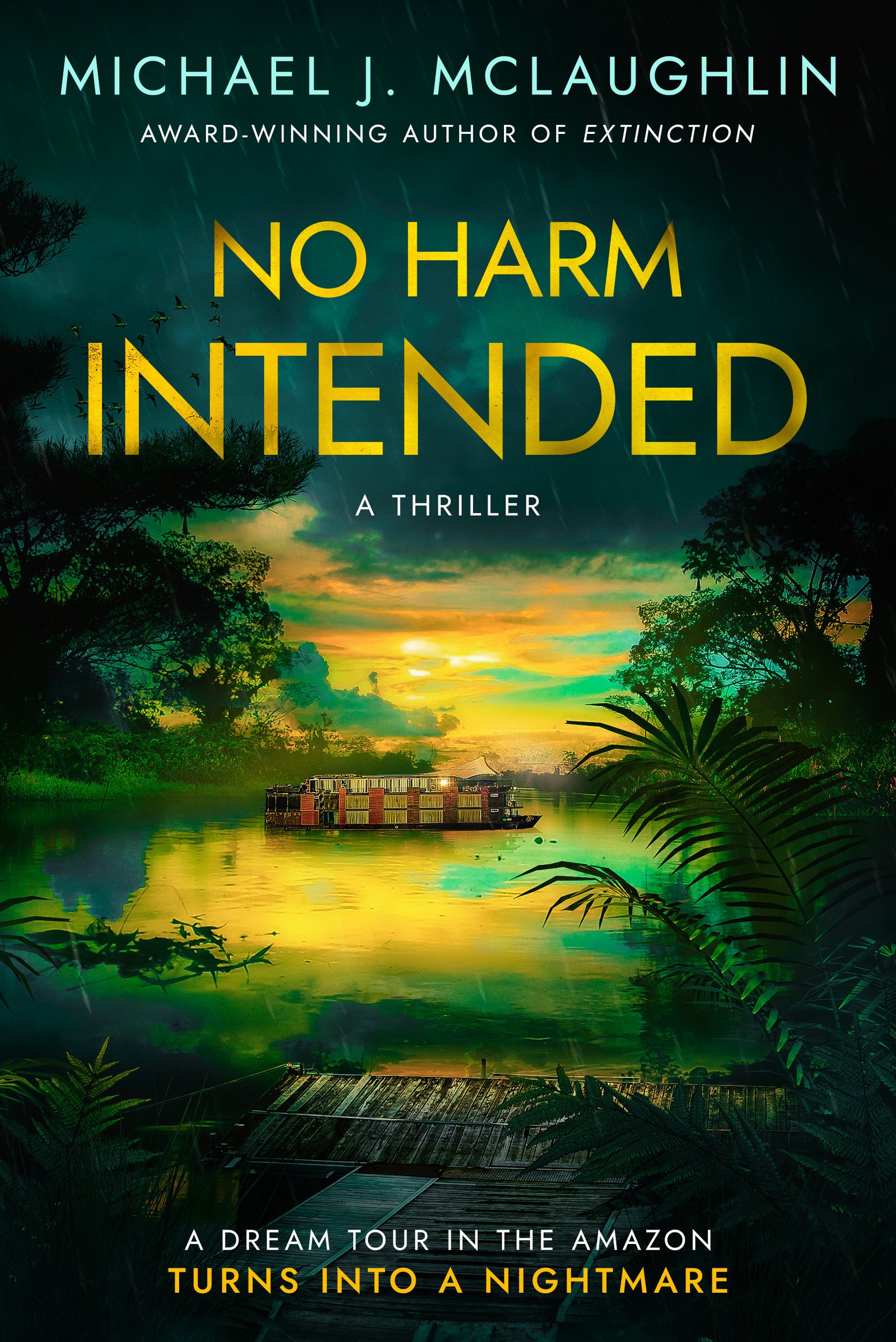
A. Whit is a wise-ass doctor, kind of like someone I know. Barely out of med school, he fights to save fellow hostages who are wounded during the initial attack or get sick while in captivity. He’d ask me why I sent him on this god-awful cruise through the Amazon instead of to a resort on a white sand beach.
He would repeat his complaint at the start of the book: “Nature’s okay. But I do hate mosquitos. Oh, and stifling humidity and murky water.” But then he’d admit he would do anything to support his eco-influencer girlfriend, Meadow. We’d raise a toast to her with his favorite cocktail, Grey Goose and tonic, not “tropical drinks with cute names.”
Q: What's one thing you hope readers take away from this book?
A. No Harm Intended is loaded with moral ambiguity. As the title suggests, most of the characters are well-intended but also flawed. Conviction drives the decisions they make, for better or for worse. I held some of them accountable for their actions but let others escape unscathed. That’s real life, I suppose.
I’m hoping this book will leave readers discussing the ecological plight of the Amazon rainforest, the vast gray zone that exists between peaceful protests and violent extremism, and how far they’d go to protect themselves and their loved ones.
Q: What question did you want me to ask, and what is your answer?
A. What inspired you to write this story? In 2022, my wife and I took a guided tour of Peru that included a five-day cruise along the Amazon and its main tributaries, the Marañon and Ucayali Rivers. Our small boat was straight out of Death on the Nile. The amazing trip left us with a deep respect for the rainforest, the local communities, and our guides.
A week after we returned home, Amazon villagers siezed the tour boats where we’d been to protest an oil spill, temporarily taking passengers hostage. Everyone was released unharmed. The tourists even publicly supported their captors’ cause on social media afterwards.
The Amazon rainforest and the catastrophe of the many oil spills there served as the perfect setting for a thriller. I asked myself, “What if a similar hostage situation there went terribly wrong?”
The Big Reveal
Now let’s see how good a sleuth (or guesser) our readers are. Please reveal all.
The lie is that I write romance novels under a pseudonym. I added that one to make my three daughters say “eeeeew.” They’re caught up on the Sarah J. Maas ACOTAR series, of course, but if my characters even hold hands, it’s way out of line.
I’ve completed many marathons, a 50-mile ultramarathon, and a bunch of triathlons, including the Lake Placid Ironman. I also ran up Mount Washington in New Hampshire and have a bumper sticker to prove it. Exercise is meditative for me, providing fleeting moments of writer-runner’s high, including solutions for broken plotlines and inspiration for boring characters.
My first date with my wife was a college road trip from Boston to South Carolina with a friend. It involved an arrest (the friend, for driving 15mph over the speed limit, if you can believe that), a hospitalization (my wife, for what I much later diagnosed as toxic shock), and a totaled car. I’d like to say the totaled car wasn’t my fault, but…I tried to make a U-turn on a flooded country road and sunk the poor thing in a swamp. I was a big hit with the future in-laws for a while after that.
Here’s a blurb for and some links where you can find Michael's latest:
Book Blurb for No Harm Intended
Nobody was supposed to die.
In this psychological thriller from the author of Extinction, a routine journey through the Peruvian Amazon turns into a nightmare of malicious deception and twisted morality.
When villagers protesting a nearby oil spill seize a small tour boat, the passengers cling to hope that reason will prevail. But hostage negotiations stall, and a new arrival concealing a disturbing agenda takes control, turning the protest into a ticking execution clock.
After escaping into the rainforest, a suspended Chicago cop must navigate hostile surroundings without weapons and evade the armed captors to reach her children before it’s too late. As the hostage crisis intensifies, secrets emerge and loyalties fracture. Pushed to the edge, ordinary people are forced to decide what they’re willing to do to survive.
No Harm Intended is a tense and unrelenting psychological thriller about resilience, revenge, and the choices that define who we become under pressure.
[Amazon paperback] Amazon e-book [Barnes & Noble]
Want to know more?
For more information about Michael J. McLaughlin https://mclaughlinbooks.com/
Posted on September 2, 2026 |
283 views
Filed under: Thriller, Standalone